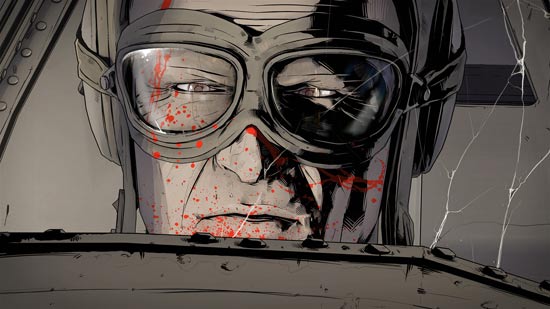
Madam Samurai Looks Like a Badass Little Graphic Novel
File this under cool things that show up in my inbox. Scar Comics is releasing the first of what is to be a two-volume graphic novel series called Madam Samurai. It’s hitting the streets in the summer of 2010.
The first thing that caught my eye was that it was written by Gary Young, the screenwriter for both The Tournament and the Michael Caine revenger, Harry Brown. I’ve seen both films and love them each for different reasons. Harry Brown in particular was an amazing and mean little drama and I can’t wait for the rest of North America to catch it on DVD and Blu-Ray.

Gary Young writes tough as nails scripts so I can’t wait to see what he does when turned loose on a comic book. And comic fans on both sides of the Atlantic will get a chance to see what he can do with the graphic novel form in June.
A quick synopsis for the story reads as follows:
Madam Samurai is a hard hitting historical adventure drama that spans the battlefields of feudal Japan and the crime ridden streets of Victorian London.
Look for it in the April 2010 edition of Diamond Previews.
Here’s a couple of unlettered preview pages by the series artist Dave Hitchcock who has previously won an Eagle Award in 2005 for his artwork on Springheeled Jack.


And here’s a nifty trailer for the book.
A Quick Talk with Comics Legend Tony DeZuniga
February 17, 2010 by admin
Filed under Featured, masters of ink
Tony DeZuniga is a comics legend who has been working in the industry since the age of 16 or in 1957 if you prefer. In the 60’s and 70’s he moved back and forth between the Philippines (his native country) and New York City working for both Marvel and DC Comics. That means he’s forgotten more about comics than you or I will probably ever learn. Later on he worked as a conceptual designer in video games and now in retirement he does commissioned paintings and teaches art. In 2010 he’s still at the top of his artistic game and it’s a big year for him with the upcoming release of the Jonah Hex movie.
First professional work (piece / year) and maybe a quick story behind it.
My first work was that House of Mystery, it’s about a Pharaoh and his son, Joe Orlando wanted to try me if my work is as good as my portfolio because he was impressed when I show him my portfolio.

Self-taught or formally educated? (or mixture of both, mentors etc…)
I was just self taught with the help of Filipino comic illustrators like Coching and Redondo and a few more that’s ahead of me. Always try to ask and make room for improvement. And you have to memorize your anatomy, that’s very important.
Tools of the trade: Taking a quick glance over at your pens, brushes etc…what tools have you mainly been using over the last few years?
Actually I use everything, and try to be good with everything. But I think pencil is my forte. I started doing fine arts too and I love acrylic and gouache.

Favorite brand of ink:
I am using this sable pen brushes, they’re expensive but I love it they’re so think and so smooth to use.
Type of paper:
I like the vellum kind , the one with tooth, I’m a pencil person so I want something that sticks on the paper.

Which artists or creators do you return to for a quick boost of inspiration? Who are the masters of ink?
I love the works of Hal Foster and Alex Raymond, they’re my inspiration growing up and starting as an artist and I know I’m not alone, a lot of artist feels the same.
Tony DeZuniga Art Exhibit Opening
Once a client has handed off an illustration job to you, how do you first tackle the job? Could you provide a quick overview of your process?
Doing a commission is very tricky, I wish all customers would tell you that “do whatever you want , as long as I get my character” but the thing doing commissions are, they’re paying you so they want certain things, certain poses, with another character, they want an evil witch…etc. But customer is always right…
What’s currently sitting in your mp3 / CD player / turntable?
I love jazz music and Frank Sinatra, Steve Lawrence, Eydie Gorme and Michael Bubble.

What’s hanging on your walls and what is your favorite piece of art that you own (not created by you)?
I love a Joe Kubert spread he gave me long time ago; a picture of me and Bill Gaines in the 70’s; a San Julian pencil and Maroto colored illustration with lots of appreciation and story behind it.
Last novel you read and last movie that you saw (that you’d recommend)?
I don’t really read novels but I love watching movies. I love the Avatar movie. I used to be a conceptual designer of SEGA and how I miss that job.

Current and upcoming projects?
My upcoming project is the Graphic Novel of Jonah Hex. The movie is coming out in June 16, 2010 and Paul Levitz, DC President wrote us a letter that they will give me a credit on the movie and we were invited at the red carpet.

What would you tell an aspiring artist who is working his ass off but still needs and wants to break through to the next level?
Just keep on trying, and most important is you have to have your own style, all new artists wanted to be like Jim Lee or Todd Macfarlane, no you have to develop your own style to get there and of course you have to be really good and sometimes….luck.
Read more about Tony at alanguilan.com
Video Interview with TONY DeZUNIGA
Killer new Jason Shawn Alexander Art for Marvel Zombies Return
It’s no secret that we’re huge fans of the art of Jason Shawn Alexander around here. His pen and ink artwork is quickly ranking up there with the masters and his painting skills are second to none. He’s been updating his blog with a lot of new pen and ink sketches, oil paintings and comic book art.
He’s been working on the Marvel Zombies Return series which features one my favorite renditions of Wolverine that I’ve seen in some time. The artwork has a manic and insane quality to it that fits in with the lunatic humor of the ongoing series of miniseries.

In addition Jason’s been drawing and painting up a storm for his upcoming gallery show at the Corey Helford Gallery coming up on May 8th.


Wesley Allsbrook; An Interview with an Accomplished Illustrator
February 11, 2010 by admin
Filed under Featured, masters of ink
by Jason Thibault
Wesley Allsbrook is a very skilled illustrator who has worked with magazines, newspapers and in the comics medium. She studied at the Rhode Island School of Design and became a freelance artist after graduation.
What inspired you to first start drawing? Did you struggle in your formative years or did it come easy to you?
I always drew. I wasn’t always good with it, but I cannot remember ever not wanting to draw. I used it, at first, to see the things that I imagined, and to make a better world for myself. Later, I drew photo real copies of the models in the Coldwater Creek catalog to impress people in middle school. There was another girl who could really throw down, Molly Carlson. North Chatham wasn’t big enough for the both of us.
First professional work (piece / year) and maybe a quick story behind it.
I got my very first jobs from my professor’s wife while still in school. In Chris Buzelli’s classes, there was always at least one assignment that would be published, though every assignment was a competition with a definite victor and loser (we voted during crit). I got second place for the Bells and Whistles job (a half page that appears consistently in PLANSPONSOR Magazine), and then I got hired. At the time I was still doing everything with screen printing, so the revises were kind of difficult for me…

Were you self-taught or formally educated? (or mixture of both, mentors etc…)
Both. I taught myself how to draw up through high school, but RISD really helped me do something with my aptitude. I had a foundations teacher called Brice Hobbs. Always questing after the most volumetric of blacks and the most visceral mark making, He’d put one of our skeletons through a tire swing, give her a sunbonnet, and address the class: “I want to FEEL this tire RUNNING OVER MY FACE.” If my drawings have any feeling of physicality, it’s because of Brice. Him and Tony Janello. Tony taught me all about the value of pentimenti as drawing tools. We’d use crayola crayons to make a literal neural net of marks around the model before drawing the figure out of the fray. After that I never looked for the outline of a thing straight away. I still draw like this every day. Helps me to see space.

Tools of the trade: Taking a quick glance over at your pens, brushes etc…what tools have you mainly been using over the last few years?
I love the Windsor and Newton Series 7 brushes (0, 1, 2) and the fountain brush pens (Pentel, Kaimei, etc), cheap sumi brushes for dry effects and toothbrushes, foam paint brushes, sharpened chopsticks… And drop-lead pencils for drawing, usually no softer than a 2B. Vellum Bristol for drawing. My boyfriend and I are deadlocked in the debate on the merits of kneaded vs. white erasers, though neither of us like the gums. For mistakes, I like casein.

How has your toolbox evolved compared to when you first started out?
When I began I wanted to use everything. I made my own oil paints from scratch (way less hazardous to your health than making pastels), and found a way to layer inks between oil varnishes (really awkward). I inked over screen prints. I even tried collage. There was not a material by which I was not at one time seduced. The smells, the textures, the line qualities… But I was always a person who thought more in lines than in volumes, so gradually, as my style became more specific my “toolbox” got smaller. The screen printing did help me to understand how to use Photoshop to my advantage.

Favorite brand of ink:
I don’t discriminate, and I buy cheap. No waterproof.
Type of paper:
Vellum Bristol.

Which artists or creators do you return to for a quick boost of inspiration? Who are the masters of ink?
I love Milton Caniff (Terry and the Pirates, and the later Steve Canyon), Noel Sickles (emphasis on the Scorchy Smith), Alex Raymond ( Flash Gordon ), Will Eisner, Kurtzman, Kirby… But for your modern influences you’ve got Paul Pope, Nathan Fox… There’s more blood and guts (you know, in a good way) in those inks than maybe I’ll ever got to do. All these guys can draw, and that’s what I love.

Once a client has handed off an illustration job to you, how do you first tackle the job. Could you give us a quick overview of your process?
I sketch, get approval. Then I scale up the print size by a quarter or a half and start penciling. I don’t transfer directly from the sketch because I don’t have the patience for the light box, and often I’ll like the idea of the sketch, but feel that the composition needs some tweaking. Once the pencil is done and a few quick thumbnails for me to figure out the value structure I want to pursue, I ink. Then I scan my ink along with some textures and perhaps some color swatches that I want to select from, and the rest, as they say, is Photoshop.

What’s currently sitting in your mp3 / CD player / turntable?
David Byrne & Brian Eno, Everything that Happens.
What’s hanging on your walls and what is your favorite piece of art that you own (not created by you)?
Has to be my boyfriend’s drawings. He inks like a man. And my friend Ze’s prints.
What’s the last novel you read and last movie that you saw that you’d recommend? Which movies and books do you always return to?
The last book I read was Peter Carey’s His Illegal Self. Le Deuxieme Souffle–The Second Wind, directed by Jean-Pierre Melville (or Le Samourai directed by the same guy) for my movie recommendation. And I just saw The Third Man! Talk about great compositions and absolute blacks…. Peter Carey is a very pleasant and familiar place to return to for reading materials. I also love Keri Hulme. Whether it’s her short stories or novels, I’ve never felt closer to written characters–and her commitment to descriptive food details really resonates with me. And anything by Calrice Lispector. And comics.

Current and upcoming projects?
My Comic, Mountains and Valleys, about the tragedy of the love between parent and child, and Nkisi Dolls. I’m hoping I can eventually self-publish. We’ll see.

What would you tell an aspiring artist who is working his ass off but still needs and wants to break through to the next level?
Keep working, but don’t do it in the dark. Let people know that you exist, and don’t lose your commitment to making the work that you love (as opposed to what you believe your clients want you to make). As a student, Jon Foster told me that the squeaky wheel gets the grease. Truer and more axiomatic words were never said, especially when it comes to illustration. A good part of this job is exposing yourself. As a shut-in, I get shaky every time I’m in a room with more than a couple of people. Its worth it to promote yourself, though.
Find out more about Wesley at her website and her blog.

Arik Roper’s Mind-Altering Art and Illustrations
November 2, 2009 by admin
Filed under Featured, masters of ink

By Jason Thibault
Arik Roper is an artist who transcends time. You stumble across his art and you think you’ve found some long-lost illustrations from the late 60’s to mid 1970’s era. Yet somehow his work perfectly complements the various album covers and concert posters of modern-day rock and metal groups. He is endlessly toiling with new materials and techniques it is of no surprise that his art is growing in popularity.
What inspired you to first start drawing? Did you struggle in your formative years or did it come easy to you?
I started drawing around age 3. Both my parents were artists. My mother was an illustrator and graphic designer and my father was a painter and sculptor, so the influence came from them and the environment in which I was grew up. They always encouraged me. There was never a question as to what I wanted to pursue – it was always art. My formative years, when I was trying out different styles and emulating things I liked, progressed fairly smoothly. In retrospect I can see different phases I went I went through as I learned. I started out on the 1960s Mad magazines, and underground comix ( my father’s collection). Later it was Heavy Metal mag, Iron Maiden covers, Vaughn Bode, some skateboard art and so on. At first I somewhat emulated my favorite art as most people do when they’re young, but over the years I think I’ve distilled it into a more unique thing although some of the early influences are so deep that they show at times.

First professional work (piece / year) and maybe a quick story behind it.
I’m not sure if this would be considered “professional” since I didn’t actually get paid for it but one of my first published pieces of work was a comic in the third issue of Grand Royal magazine in 1994. I met the editor Bob Mack when he visiting New York through some friends. We hung out one night, went to bars , acted crazy, had a blast and ended up staying in touch for a time after that. He asked me to contribute to the magazine, so I submitted a primitive one panel comic which was used. I later did another for the next issue ( I think it was the next issue) but some others at the magazine weren’t into it because it was insulting to owners of pit bulls- it was basically just a parody strip about how people who own pit bulls as a status symbol are idiots. I think the magazine folded soon after, for different reasons I assume.

Were you self-taught or formally educated? (or mixture of both, mentors etc…)
I learned a lot from my mother. She started as a fashion illustrator then became a commercial illustrator in the 1970s, when they had to actually draw advertisements and do it all manually. She was good at creating anything. Her style definitely influenced mine. I picked up a lot of technique from her and started using her markers and paper. She also had volumes of art books laying around the house for reference which I was exposed to. By the time I got to The School of Visual Arts I had been into drawing and coloring for many years and was well on my way. In school I was exposed to other mediums like painting, figure and life drawing, silk-screening, etc, so in that sense school helped but most of what I learned happened when I was younger.

Tools of the trade: Taking a quick glance over at your pens, brushes etc…what tools have you mainly been using over the last few years?
These days I use a crow quill pen, Micron markers, various watercolor and acrylic paint brushes, plus other watercolor pattern making tools like sponges.
How has your toolbox evolved compared to when you first started out?
I used to work with permanent markers like Prismacolor, sharpies, etc., but the fumes were too much, plus they’re limited in regards to what you can achieve. Now I’m into permanent inks, watercolors and gouache. These give me the effect I was looking for with markers- deeply saturated but much more versatile. I’ve been moving more into painting lately too.

Favorite brand of ink:
Dr Ph Martins Radiant Concentrated and Transparent water color inks are what I’ve been into lately. I’ve been also using various brands of gouache for some opacity.
Type of paper:
I use primarily Arches Cold Press 300 lb paper. Sometimes the 140 lb Hot Press also. The Cold Press heavyweight type works best for me because I use a lot of layering, I mix the colors into the paper and do washes so I need the paper to hold up. The Arches is good at this, it gets soaked and dries into a nice deep tone. If I’m doing a sharper illustration in which there’s a black outline for example, then the smooth Hot Press is better. If it’s a single sheet, I get it wet then iron it out to keep it from warping and tape it down on a board.

Which artists or creators do you return to for a quick boost of inspiration? Who are the masters of ink?
Just to name a few: Edmund Dulac, Ivan Bilibin, Augustus Knapp, Gustave Dore, Theodor Kittelsen, Heath Robinson, Robert Pepper, Richard Corben, Frazetta, Berni Wrightson, Jeff Jones, Ian Miler, Julek Heller, Rodney Matthews, Roger Dean, Greg Irons, Gerald Scarfe, Peter Dickinson, Giger, Ernst Fuchs, Rick Griffin, Barney Bubbles, R Cobb, Bruce Pennington, George Hardie, Phillipe Druillet, V Courtlandt Johnson, William Stout. There are many contemporaries who I admire as well, too many to get into here.

Once a client has handed off an illustration job to you, how do you first tackle the job. Could you give us a quick overview of your process?
Fortunately I get to be creative with a lot of my work, meaning that I get to come up with the imagery on my own. Sometimes brainstorming can take a while. I spend some time thinking about the concept or client and what I want to represent with it. I try to take cues from the client, a band for example, I’ll use the music to guide me. Sometimes I’ll get into researching ideas or themes, I’ll read about the history of some theme that I’m working on. I sketch out ideas for a while until I get something I like then go to the final. The rest of the process varies depending on the project and style. I’ve lately been working in a style in which I don’t draw the image in black line, I use only inks to make the scene a more realistic style. That’s a whole other way of thinking for me, because I have to think about the order in which I lay down the colors, and use the ink and water to create effects. It requires a little more patience and consideration.


What’s currently sitting in your mp3 / CD player / turntable?
On the turntable sits The End of the Game, by Peter Green.
What’s hanging on your walls and what is your favorite piece of art that you own (not created by you)?
I can’t say it’s necessarily my favorite but it ranks high on my list, it’s a poster print of a painting titled A Walk Through the World of Drugs by John Pitre. A friend gave it to me from his collection. It’s a scene of some naked shaggy looking young men and women basking in a world made of phantasmagorical oversized pills, mushrooms, cocaine and pot leaves. It’s really a beautifully done oil painting with incredible detail and amazing psychedelic renderings plus it’s insane in concept, which I like of course. I’d never heard of Pitre but after researching him, I discovered he’s a huge talent.
I also have a screen printed poster which is apparently from the 70s by an Israeli artist named Shoher ( it’s in the fine print ) that depicts Jesus on the cross wearing a gas mask and all kinds of demonic post apocalyptic chaos surrounding him , and the words “And Then Came Smoke”.

What’s the last novel you read and last movie that you saw that you’d recommend? Which movies and books do you always return to?
Most of my life I’ve been reading nonfiction (except for Philip K Dick) but over a year ago I read Dune for the first time. I never got around to reading it when I was younger, and I’m glad I didn’t because it blew me away after reading it at this age. I think I related to it more and had some reference points for it that made it all the more outstanding to me. It’s so incredibly psychedelic, I can’t believe no one told me before. I heard from a firsthand source that Frank Herbert created the story from his psilocybin experiences and that certain characters and the overall vibe of the story are directly influenced by the mushroom lore and biology – and it shows. Dune has some of the most spot-on altered state descriptions I’ve ever read, it’s a heavyweight masterpiece to be sure. I saw the David Lynch film version as a kid, I liked it but didn’t quite get it. It’s an interesting film but of course it’s hugely abbreviated and a bit frustrating because of it.
Another inspiring book is the Secret Teachings of All Ages by Manly Hall, the giant tome of occult and secret sciences through history. That stuff get’s my mind on its’ feet.
Solaris by Tarkovsky is one of my favorite movies and it’s always inspiring. Jodorowsky’s The Holy Mountain and El Topo are classics in my world as well, the symbolism and humor are amazing.

Current and upcoming projects?
I’m currently working on art for my show which opens in late October at the Fuse Gallery here in New York. After that I start thinking about the new High on Fire album art, and some other projects including a graphic novel idea that a friend and I are developing. I’d like to get into animation but since I don’t yet have the skills to do it alone, I think I’d need to collaborate with someone.
What would you tell an aspiring artist who is working his ass off but still needs and wants to break through to the next level?
You gotta be good at what you do. Keep making art, looking for inspiration, and refining your craft. I suggest looking at art through the ages for inspiration, not just modern trends. In terms of getting to the “next level”, it’s often a matter of just getting yourself seen and then letting it grow from there. It’s easier now than ever. You can show your work online , you can make your own prints or shirts, etc., you can self publish with those print on demand books. You can do work for bands which is like an advertising circuit unto itself. Build a world around you, make your personal aesthetic universe for your art. Then, if you want, you can send it out to potential clients or agencies to get some work. But you have to be good at what you do of course. It may take time. You may not feel like you’re reaching your goal yet, but that’s alright because time is on your side as an artist. If you keep doing it you’ll presumably evolve and by the time it starts reaching people it will be even better. Don’t rush it, develop it.
Keep up with Arik at his website.